 320dbcacba
* [SourceGenerators] Add the SysAbi export generator and analyzers (phase 0)

New SharpEmu.SourceGenerators Roslyn component, complete and tested but
consumed by nothing yet — the emulator projects adopt it in the
following commits.

Ps5Nid ports the PS NID derivation (base64 of the byte-reversed first
eight SHA1 bytes of name + fixed suffix) from
scripts/generate_aerolib_binary.py to C#, so what has always been a
manual, out-of-band computation becomes a compile-time capability.

SysAbiExportGenerator emits a per-assembly SysAbiExportRegistry whose
CreateExports(Generation) reproduces ModuleManager's reflection scan
exactly — same generation inheritance and filtering, same method-name
fallback, same libKernel default — with attribute-omitted NIDs derived
algorithmically (equivalent to the runtime catalog lookup, which is
built from the same computation). Parameterless handlers are adapted to
the SysAbiFunction shape; invalid declarations are skipped here because
the analyzer rejects them as build errors, so nothing drops silently.

SysAbiExportAnalyzer turns the runtime failure modes into diagnostics:
SHEM001 duplicate NID (across declared and derived forms), SHEM002
malformed NID, SHEM003 uncallable handler signature, SHEM004 NID
contradicting its export name (the class of drift previously fixed by
hand), SHEM005 unresolvable export, SHEM006 export name unknown to
ps5_names.txt when the catalog is wired as an AdditionalFile, SHEM007
handler not reachable by generated code.

The self-contained test suite drives both in-process against the real
SharpEmu.HLE metadata: known catalog NID pairs pin the algorithm, the
generated registry must itself compile, and each diagnostic has a
triggering fixture. Fittingly, the NID pinning test caught a wrong
pair in its own first draft — the exact mistake SHEM004 exists to stop.

* [SourceGenerators] Adopt the generated export registry in the emulator (phase 1)

SharpEmu.Libs consumes the generator and analyzers, with
scripts/ps5_names.txt wired as the AdditionalFile catalog. The runtime
now registers exports from the compile-time SysAbiExportRegistry
instead of the boot-time reflection scan; RegisterFromAssembly is
retained solely as the arbiter for a parity test that pins the two
tables identical — same NIDs, names, libraries, targets, and handler
methods — across Gen4, Gen5, and combined registration.

First contact between the analyzer and all 715 existing exports
surfaced real drift the old offline checker structurally missed
(scripts/check_sysabi_aerolib.py skipped any NID absent from
aerolib.bin): three exports whose friendly names collide with real
catalog symbols of different NIDs, now suppressed at-site with reasons
pending AGC API confirmation, alongside the established synthetic
Unknown* labels for uncatalogued NIDs, which prompted a rule
refinement — SHEM004 only hard-errors when the export name is a real
catalog symbol, since synthetic labels cannot be validated by hashing
and the NID is authoritative for them. The two allowlisted mismatches
in the python checker no longer trigger anything, and the checker is
deleted: the analyzer subsumes it with the semantic model instead of
regex, and validates every declared pair rather than only
catalog-known NIDs.

* [SourceGenerators] Generate aerolib.bin at build time from ps5_names.txt

The runtime NID -> name catalog is derived data and no longer lives in
the repository: a Framework-only MSBuild task (GenerateAerolibBinaryTask,
sharing the same Ps5Nid implementation the analyzers use) builds it
into the intermediate directory from scripts/ps5_names.txt — now the
single source of truth — and SharpEmu.HLE embeds it from there. The
output is byte-identical to the previously committed binary, verified
with cmp against git history; a new test pins that the embedded catalog
loads and resolves a known symbol both directions.

scripts/generate_aerolib_binary.py is deleted (its algorithm lives in
Ps5Nid, its invocation in the build); the REUSE annotation for the
binary goes with it. MSBuild's Inputs/Outputs check means the ~154k NID
hashes only recompute when the names file actually changes. The task
implements ITask against Microsoft.Build.Framework directly, keeping
the vulnerable-flagged Utilities.Core package out and the analyzer
project's file-IO ban suppressed only inside the task itself.

* [SourceGenerators] Emit typed-signature register thunks (phase 2)

[SysAbiExport] handlers can now be written with real signatures — a
CpuContext followed by up to six int/uint/long/ulong parameters — and
the generator emits the SysV unmarshalling thunk, mapping parameters
positionally to RDI/RSI/RDX/RCX/R8/R9 with the same unchecked-cast
idiom hand-written handlers use. SHEM003 accepts the new shape and
rejects register overflow and non-register-representable types. Both
shapes coexist, so migration is per-handler; sceKernelPollSema,
sceKernelSignalSema, and sceKernelCancelSema migrate as the
demonstration (the last showing raw ulong guest-address passthrough).

The reflection scan cannot represent typed handlers, so it retires
here: RegisterFromAssembly, its signature validation, and
ResolveExportInfo are deleted, and the parity test that pinned the
generated registry to the scan is replaced by content-invariant tests
(duplicate-free, full 715-export surface, catalog identity). Deleting
the scan surfaced a phase-1 latent regression — the pre-JIT warm sweep
enumerated only reflection-scanned assemblies, so the generated
registration path warmed nothing and re-exposed the guest-thread
fail-fast risk; the warm set is now derived from the registered
handler delegates themselves.

* [SourceGenerators] Marshal guest strings declaratively with [GuestCString] (phase 3)

A string parameter on a typed [SysAbiExport] handler, annotated
[GuestCString(maxLength)], now makes the generated thunk read the
null-terminated UTF-8 string from the argument register's guest
address before the handler runs, returning
ORBIS_GEN2_ERROR_MEMORY_FAULT to the guest when the read fails —
the exact prologue nearly every string-taking handler writes by hand.
The attribute lives in SharpEmu.HLE next to SysAbiExportAttribute;
SHEM008 rejects misuse (non-string parameter, non-positive MaxLength)
while a bare string parameter stays a SHEM003 signature error.

_open, open, and sceKernelOpen migrate as the demonstration; they were
chosen because their hand-written prologue faulted on a null pointer
the same way the thunk does (handlers that return INVALID_ARGUMENT for
null pointers, like sceKernelCreateSema, keep the raw shape so guest-
visible semantics stay untouched).

* [SourceGenerators] Apply review findings across the branch

Behavior: the open/_open/sceKernelOpen [GuestCString] demo migration is
reverted — the local compat reader falls back to host memory for paths
in loader-mapped regions that ctx.Memory cannot see, so the generated
thunk would have turned recoverable reads into MEMORY_FAULT. The
marshalling infrastructure stays, proven by generator/analyzer tests;
production migration waits for a handler whose semantics the thunk
reproduces exactly. A comment on the handler records why.

Build robustness: the aerolib target is skipped for design-time builds
(the IDE resolves project references without compiling them, so on a
fresh clone the task assembly does not exist yet), and the task/names
paths are centralized in properties. The generator now emits no
registry for export-free assemblies, so referencing the analyzer can
never mint a colliding SharpEmu.Generated type.

Cleanup and perf: the pragma-suppression sites left mis-indented by the
phase-1 relocation are reformatted and the restores moved after the
method body; the dead ExportsForTesting hook and its InternalsVisibleTo
are deleted; the aerolib task reuses one SHA1 instance across ~150k
names; the analyzer caches the parsed catalog per file snapshot instead
of re-parsing 150k lines every compilation start, shares the attribute
name constant with the generator, and computes the catalog-membership
check once.

* [CI] Run the test suites in the build workflow

The workflow compiled the test projects (they are in SharpEmu.slnx) but
never executed them. A solution-level dotnet test now runs between
build and publish, so any test failure fails the build — including the
AerolibCatalogTests/SysAbiRegistryTests that guard the build-generated
aerolib.bin and the generated export registry. Generation failures of
aerolib.bin itself already fail the build step: the MSBuild task logs
an error event and returns false, and a missing task assembly or
missing embedded output are hard MSBuild errors. The NuGet cache key
now also tracks the test projects' lock files.

* [SourceGenerators] Address review feedback

Multi-diagnostic analyzer tests no longer assume a stable diagnostic
order (analyzer execution is concurrent), and the aerolib task logs
the full exception instead of only its message so build failures keep
the type and stack trace.

* [SourceGenerators] Address second review round

Symbol-name comparisons in the shape rules and analyzer now pin an
explicit SymbolDisplayFormat.FullyQualifiedFormat instead of relying on
the display-format default, and the aerolib task fails loudly on a
symbol name that would overflow the format's ushort length prefix
instead of silently truncating it, with null-safe output-directory
handling made explicit.

* [SourceGenerators] Embed aerolib.bin via a target so design-time builds never reference it

The static EmbeddedResource item referenced the generated file even in
design-time builds, where the generation target is skipped — on a fresh
clone the IDE would try to embed a file that never existed. The item is
now created inside an EmbedAerolibBinary target gated on
DesignTimeBuild, separate from the generation target so an up-to-date
skip of GenerateAerolibBinary cannot drop the item with the rest of its
body, and hooked before AssignTargetPaths since dynamic resource items
added later miss the resource pipeline.

Verified fresh build, incremental rebuild (embedded catalog test both
times), and a simulated design-time compile with no artifacts present.

* [SourceGenerators] Regenerate test lock file after rebase onto main

Rebase fallout: main's package graph shifted under #200, so the
SourceGenerators.Tests lock file is re-evaluated to keep --locked-mode
restore green at the branch tip.

* [Build] Drop NuGet lock files; rely on central package management

Central package management was already in effect (ManagePackageVersionsCentrally
with all versions in Directory.Packages.props and no inline PackageReference
versions), so the per-project packages.lock.json files and the lock-mode
workflow only added maintenance overhead. This removes all eleven lock files,
drops RestorePackagesWithLockFile so restore no longer regenerates them, and
takes --locked-mode off the CI restore steps (re-keying the NuGet cache on the
central props files). Package versions remain centrally pinned in
Directory.Packages.props.
SharpEmu

An experimental PlayStation 5 emulator for Windows, Linux and macOS.

Join our Discord for development updates, compatibility discussions, support, and community chat.
Note
SharpEmu supports Windows x64, Linux x64, and macOS x64. Apple Silicon Macs can run the macOS x64 build through Rosetta 2.
Warning
SharpEmu is an experimental PS5 emulator developed from scratch in C#. The current focus is on accuracy and infrastructure setup rather than game-specific compatibility.
Info
SharpEmu is an emulator project currently in its early stages of development.
This project is developed purely for research and educational purposes. There are no commercial goals associated with it. We enjoy learning about system architecture and reverse engineering.
SharpEmu focuses exclusively on the PlayStation 5.
Our goal is not to emulate PS4 games, as there is already an excellent emulator dedicated to that platform: ShadPS4.
Status
The emulator can currently load the eboot.bin of real games, execute native CPU instructions, and partially handle kernel-related functionality. However, several critical components are still missing.
Current capabilities include:
- Loading
eboot.binand.elffiles - Executing native CPU instructions
- Reading basic game metadata (title, version, etc.)
- Loading system modules (
prx/sys_module) - Partial support for some kernel functions
FiberandAMPRexports- PlayGo scenarios
- Initial loading game files
- Shader/resource submits and AGC initial
- Video outputs in some games
Some games have reached like sceVideoOut and AGC stages.
SharpEmu supports Windows, Linux, and macOS hosts. Video output uses Vulkan on Windows and Linux, and MoltenVK on macOS. Platform support is still experimental, so compatibility and performance vary by game, operating system, and GPU driver.
Using
Download the release archive for your operating system, extract it, and launch
SharpEmu with the path to a legally obtained game's eboot.bin.
Windows PowerShell:
.\SharpEmu.exe "C:\path\to\game\eboot.bin" 2>&1 |
  Tee-Object -FilePath "SharpEmu.log"
Linux and macOS:
chmod +x ./SharpEmu

./SharpEmu "/path/to/game/eboot.bin" 2>&1 |
  tee SharpEmu.log
A Vulkan-capable GPU and current graphics driver are required. The macOS release includes the MoltenVK Vulkan implementation.
Games Tested
-
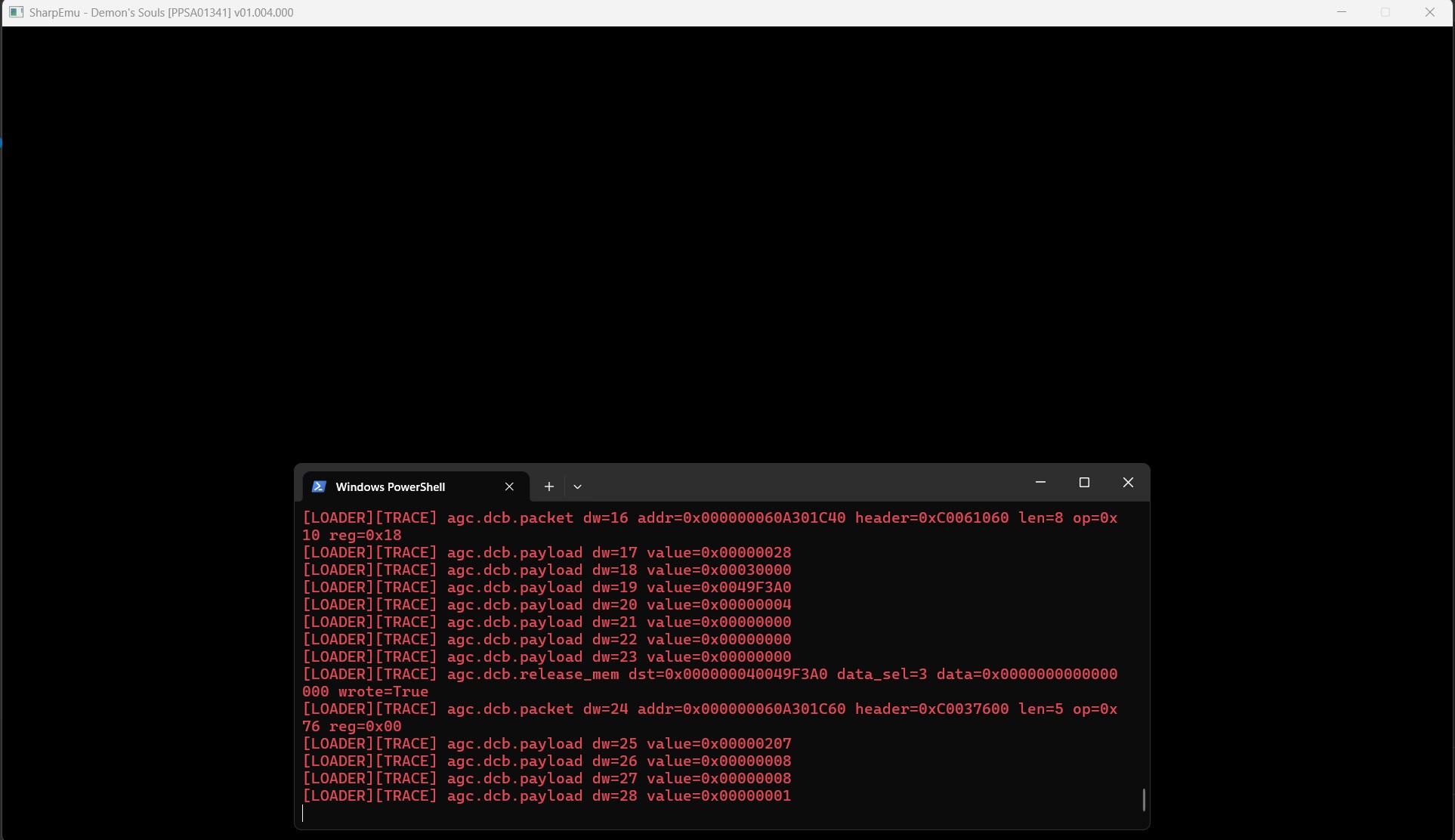
Demon's Souls Remake
- Demon's Souls [PPSA01341]
- Demon's Souls is now video loop. Shaders are ready to be converted to SPIR-V/Vulkan. We are continuing our work on this.
-
Poppy Playtime Chapter 1
-
SILENT HILL: The Short Message
-
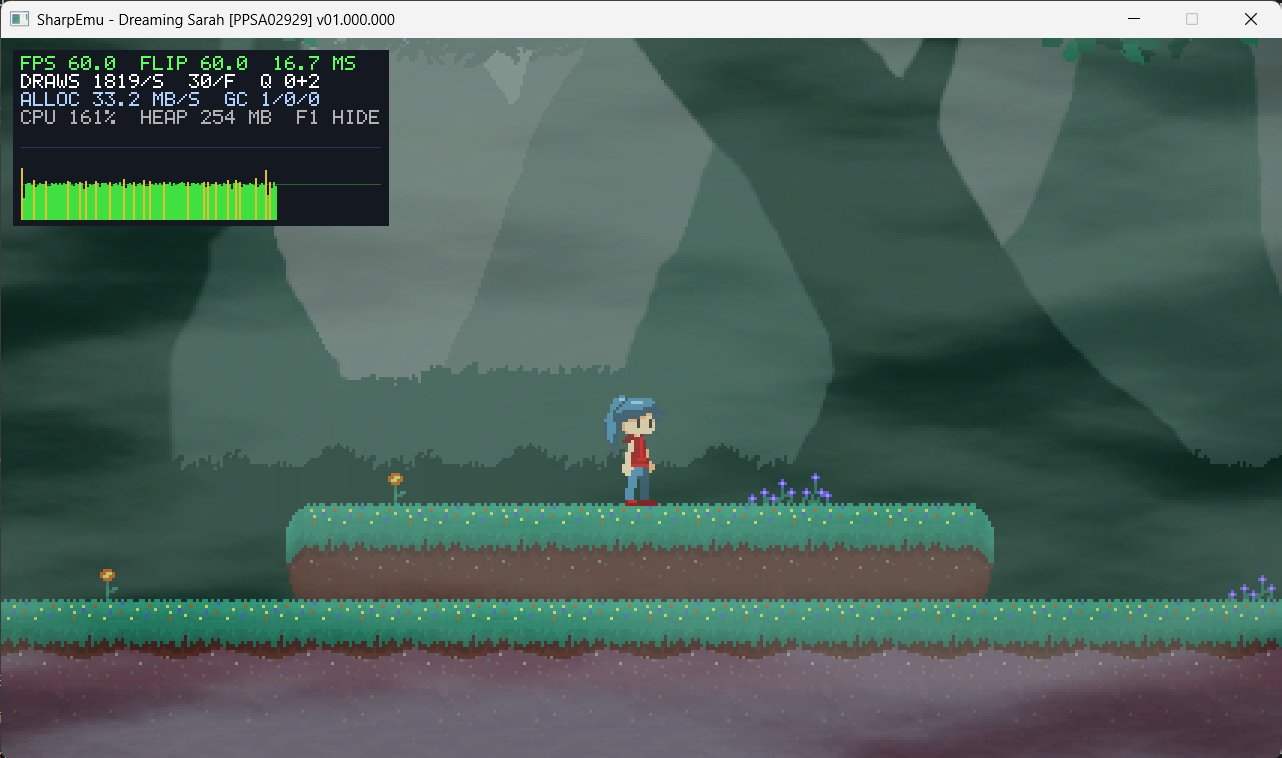
Dreaming Sarah
- Dreaming Sarah [PPSA02929]
- Real texture rendering for this game;


Important
This project does not support or condone piracy.
All games used during development and testing are dumped from consoles that we personally own.
Users are expected to use legally obtained copies of their games.
Build
- Install the .NET SDK version specified in
global.json. - Clone the repository:
git clone https://github.com/par274/sharpemu.git - Open the solution file (
SharpEmu.slnx) in VSCode. - Build the project:
dotnet buildordotnet publish - Build artifacts will be located in the
artifactsdirectory.
Disclaimer
SharpEmu is an experimental emulator intended for research and educational purposes.
This project does not contain any copyrighted system firmware, game data, or proprietary PlayStation assets.
Special Thanks
The following projects were extremely helpful during development:
-
ShadPS4
Helped with understanding the basic architecture of the PlayStation 4. -
Kyty
One of the few PS5 emulator projects available and very useful for studying native code execution. -
Ryujinx
Provided valuable references for filesystem handling and low-level C# implementation patterns.
License
Contributing
Before opening an issue or pull request, please read our contribution guidelines:
The guide covers:
- Coding style and formatting
- AI-assisted contributions
- Pull request expectations
- Testing guidelines
- Legal and reverse engineering policy