 62e1775c5c
* [HLE] Stop allocating on the memcpy/memset and trace hot paths

memcpy/memmove no longer allocate a bounce buffer sized to the whole
copy (large copies previously landed on the LOH); they loop through a
single pooled 256 KB rental, copying high-to-low when the destination
overlaps above the source so memmove semantics survive the chunking.
memset reuses a shared zero chunk for the dominant zero-fill case and
rents/fills only min(length, 16K) bytes for non-zero values instead of
allocating and filling a fresh 16 KB array per call; the map-time
zero-fill loop shares the same zero chunk.

SHARPEMU_LOG_SEMA / SHARPEMU_LOG_VIDEOOUT are now read once into cached
bools and every TraceSemaphore/TraceVideoOut call site is guarded, so
trace messages are no longer interpolated (and the env var no longer
queried) on every semaphore op and every flip with tracing off. Trace
output when the flags are set is unchanged.

* [HLE] Remove per-frame allocations from the vblank/flip/equeue plumbing

The 60 Hz vblank pump no longer allocates per edge: PumpVblanks reuses a
pump-thread-only port list instead of a LINQ Where/ToArray, and
SignalVblank/SubmitFlip snapshot their event registrations into pooled
rentals instead of copying the List on every edge and every flip (the
snapshot must still be taken, since triggers run outside _stateGate and
a per-port reusable buffer would race the pump thread against a guest
thread's first-edge signal).

sceKernelWaitEqueue delivery rents the dequeue buffer from the pool
instead of allocating an array per wait, and event-queue wake keys are
formatted once per handle (cached in a ConcurrentDictionary, dropped on
queue delete) instead of building the string on every enqueue. The
semaphore wake key moves onto KernelSemaphoreState at creation, the
same pattern the pthread mutex state already uses, removing the
per-signal/per-wait formatting. SHARPEMU_LOG_EQUEUE is read once into a
cached bool like the sema/videoout flags.

* [HLE] Read guest C-strings without per-call buffer allocations

CpuContext.TryReadNullTerminatedUtf8 allocated a byte[capacity] and
issued one TryRead per byte for every string-argument import. It now
reads through a stack buffer (pooled above 512 bytes) in 128-byte bulk
chunks, falling back to per-byte reads only when a chunk touches an
unreadable range so a terminator sitting just before unmapped memory
still resolves exactly as before. The chunk bound also keeps the
overread past the terminator smaller than the old loop's worst case is
wide, so no fault can appear where the byte loop succeeded.

TryReadAsciiZ (dlsym/symbol resolution) drops its List<byte> + ToArray
round-trip for the same stack/pooled buffer, keeping the byte-by-byte
TryReadByteCompat reads because their Marshal.ReadByte fallback must
probe exactly up to the terminator. Only the final string is allocated
on either path now.

* [HLE] Replace blocking-wait closures with waiter continuation objects

Every wait that actually parked a guest thread allocated two capturing
lambdas (plus their display classes) for the scheduler's resume/wake
callbacks. RequestCurrentThreadBlock and the backend's blocked-thread
state now carry a single IGuestThreadBlockWaiter instead of the
Func<int>/Func<bool> pair: TryWake keeps the run-under-the-scheduler-
gate contract and Resume still produces the guest's RAX on the woken
thread. The waiter stays attached through the wake transition (the old
code nulled only the wake handler there) and is consumed at resume.

The existing waiter objects absorb the captured state as fields, so a
blocking wait now allocates exactly one object: SemaphoreWaiter,
PthreadMutexWaiter, and EventFlagWaiter implement the interface
directly, and the equeue, cond, and rwlock waits get small waiter
classes replacing their closures. Handler bodies delegate to the same
static methods with the same arguments as before; the untimed event
flag wait's mutable captured result becomes a field on its waiter.

* [HLE] Back pending event queues with a ring deque instead of LinkedList

LinkedList<KernelQueuedEvent> allocated a node object on every
non-coalesced enqueue — one per vblank/flip edge per registered queue,
60+ times a second in steady state. KernelEventDeque is a grow-only
ring buffer over a KernelQueuedEvent[] with the three operations the
queue actually uses (AddLast, RemoveFirst, find-and-update-in-place by
ident/filter), so steady-state enqueue/dequeue allocates nothing and
the coalescing update writes the struct back through an indexer instead
of a node reference. All accesses stay under _eventQueueGate, matching
the LinkedList usage it replaces.

* [HLE] Cap memcpy chunk iterations at the requested size, not the rented length

Address Copilot review: ArrayPool.Rent may return a larger array than
requested, so sizing each iteration by chunk.Length let the copy
granularity depend on pool bucketing internals instead of the intended
256 KB chunking. Behavior was already correct for any chunk size (each
iteration re-reads the source, and the overlap ordering is size-
independent), but the loop now mins against the requested chunkLength,
matching what memset already does.

* [HLE] Skip the flip/vblank snapshot rental when no events are registered

Address Copilot review: SignalVblank and SubmitFlip rented (and
returned) a pooled snapshot even with zero registrations — steady
per-frame pool traffic for games that never register flip events and
only poll flip status. Zero-count signals now skip the rental, the
copy, and the trigger loop entirely, which also retires the
Math.Max(count, 1) minimum-rent guard.
SharpEmu

An experimental PlayStation 5 emulator for Windows, Linux and macOS.

Join our Discord for development updates, compatibility discussions, support, and community chat.
Warning
Currently the primary development target is Windows.
Warning
SharpEmu is an experimental PS5 emulator developed from scratch in C#. The current focus is on accuracy and infrastructure setup rather than game-specific compatibility.
Info
SharpEmu is an emulator project currently in its early stages of development.
This project is developed purely for research and educational purposes. There are no commercial goals associated with it. We enjoy learning about system architecture and reverse engineering.
SharpEmu focuses exclusively on the PlayStation 5.
Our goal is not to emulate PS4 games, as there is already an excellent emulator dedicated to that platform: ShadPS4.
Status
The emulator can currently load the eboot.bin of real games, execute native CPU instructions, and partially handle kernel-related functionality. However, several critical components are still missing.
Current capabilities include:
- Loading
eboot.binand.elffiles - Executing native CPU instructions
- Reading basic game metadata (title, version, etc.)
- Loading system modules (
prx/sys_module) - Partial support for some kernel functions
FiberandAMPRexports- PlayGo scenarios
- Initial loading game files
- Shader/resource submits and AGC initial
- Video outputs in some games
Some games have reached like sceVideoOut and AGC stages.
Currently the project primarily targets Windows. Cross-platform support (Linux and macOS) is planned, but development is currently focused on Windows to simplify early-stage debugging and iteration.
Using
- Build or Publish project or download in release tab.
- Open Powershell.
- Run Emulator GUI.
- Or command:
.\SharpEmu "eboot.bin" 2>&1 | Tee-Object -FilePath "log.txt"
Games Tested
-
Demon's Souls Remake
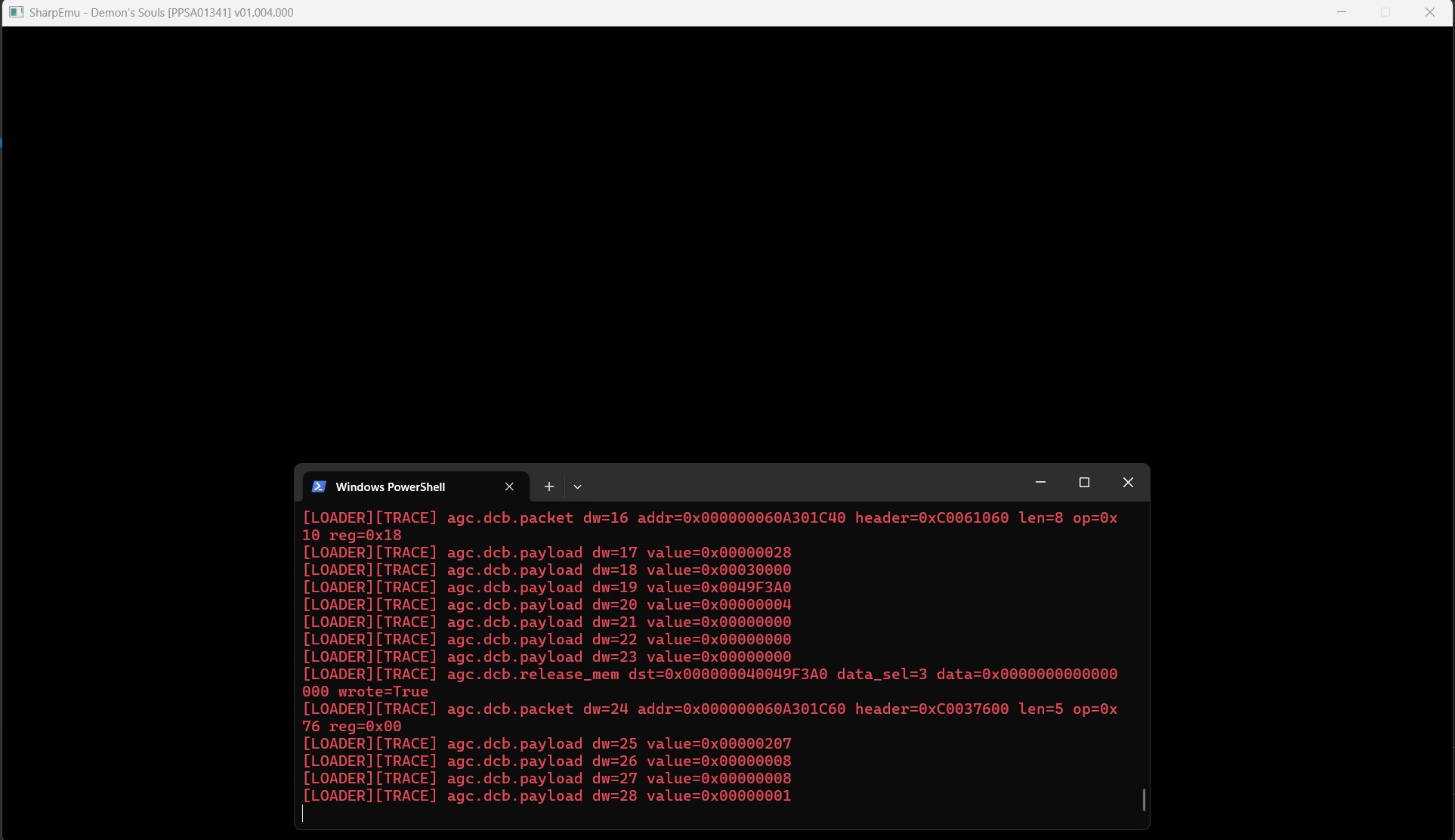
- Demon's Souls [PPSA01341]
- Demon's Souls is now video loop. Shaders are ready to be converted to SPIR-V/Vulkan. We are continuing our work on this.
-
Poppy Playtime Chapter 1
-
SILENT HILL: The Short Message
-
Dreaming Sarah
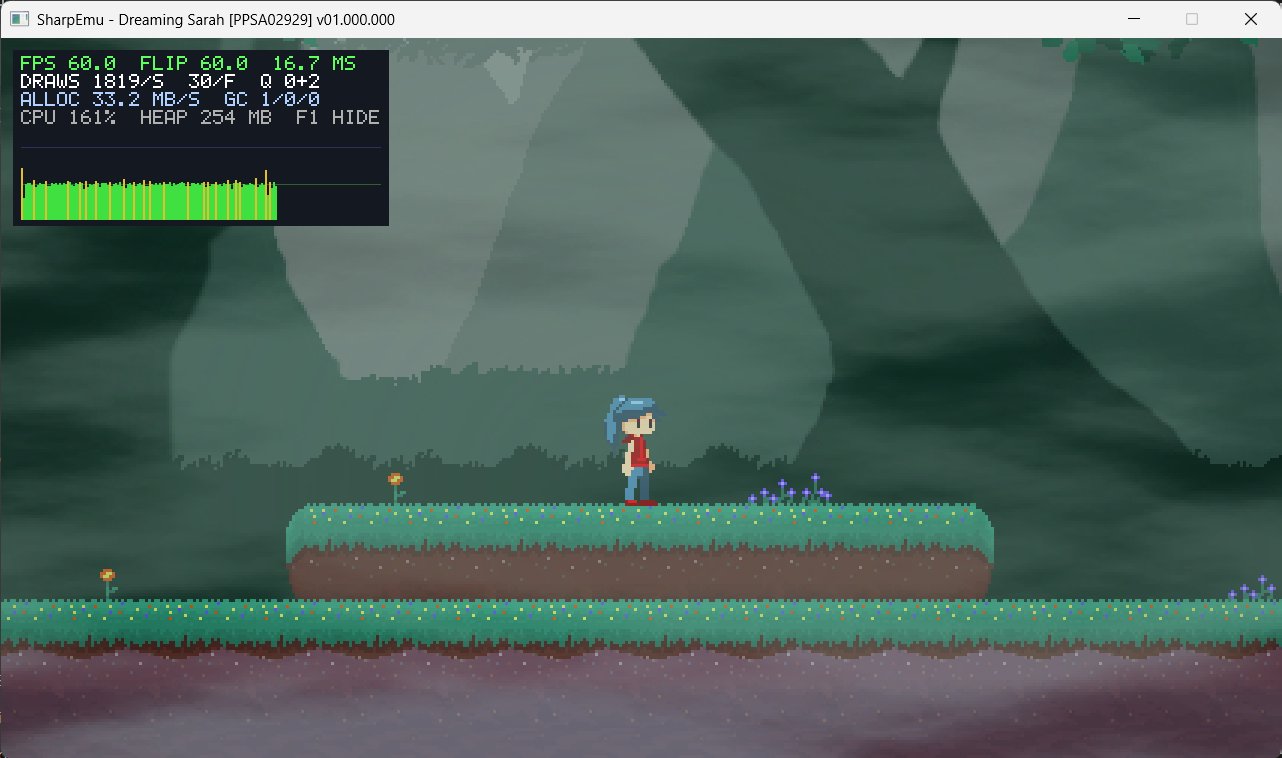
- Dreaming Sarah [PPSA02929]
- Real texture rendering for this game;


Important
This project does not support or condone piracy.
All games used during development and testing are dumped from consoles that we personally own.
Users are expected to use legally obtained copies of their games.
Build
- Install the .NET SDK.
- Clone the repository:
git clone https://github.com/par274/sharpemu.git - Open the solution file (
SharpEmu.slnx) in VSCode. - Build the project:
dotnet buildordotnet publish - Build artifacts will be located in the
artifactsdirectory.
Disclaimer
SharpEmu is an experimental emulator intended for research and educational purposes.
This project does not contain any copyrighted system firmware, game data, or proprietary PlayStation assets.
Special Thanks
The following projects were extremely helpful during development:
-
ShadPS4
Helped with understanding the basic architecture of the PlayStation 4. -
Kyty
One of the few PS5 emulator projects available and very useful for studying native code execution. -
Ryujinx
Provided valuable references for filesystem handling and low-level C# implementation patterns.
License
Contributing
Before opening an issue or pull request, please read our contribution guidelines:
The guide covers:
- Coding style and formatting
- AI-assisted contributions
- Pull request expectations
- Testing guidelines
- Legal and reverse engineering policy