 f23161be9a
* [Host] Introduce host platform abstraction with IHostMemory

Add SharpEmu.HLE/Host with IHostPlatform/IHostMemory interfaces, neutral
page-protection/region enums, and a HostPlatform.Current factory that
resolves the Windows backend (or throws PlatformNotSupportedException on
other OSes, matching today's de-facto behavior). WindowsHostMemory wraps
the exact VirtualAlloc/VirtualFree/VirtualProtect/VirtualQuery calls used
across the engine today, with identical MEM_*/PAGE_* constants.

Migrate StubManager as the first consumer: its private kernel32 P/Invokes
and enums are replaced by IHostMemory calls that issue the same two
native operations (RWX commit+reserve of the PLT arena, release on
Dispose). No behavior change.

This is the first step toward supporting non-Windows hosts; subsequent
commits move the remaining direct P/Invokes in Core and Libs behind the
same seam.

* [Host] Route PhysicalVirtualMemory through IHostMemory

Replace the class's private VirtualAlloc/VirtualFree/VirtualProtect/
VirtualQuery P/Invokes with IHostMemory calls. Every site maps 1:1 onto
the exact native call it issued before: MEM_COMMIT|MEM_RESERVE ->
Allocate, MEM_RESERVE -> Reserve, fault-path commits -> Commit, and
MEM_RELEASE -> Free, with identical protection values produced by the
Windows backend.

IHostMemory gains ProtectRaw so the save/restore protection sequences in
TryWriteExclusive and TryTemporarilyProtectForRead round-trip the raw OS
protection word (including modifier bits the neutral enum cannot
represent) exactly as before. Raw PAGE_* constants remain only for the
internal region-classification helpers, which only ever see values this
class itself assigned.

The exact-address free-on-mismatch, lazy reserve-only threshold, prime
loop, and all trace strings are unchanged.

* [Host] Add IGuestAddressSpace and retire the reflection-based allocator lookup

Introduce IGuestAddressSpace in SharpEmu.HLE (fixed-address AllocateAt /
TryAllocateAtOrAbove and guest mprotect via TryProtect) with signatures
copied from PhysicalVirtualMemory, which now implements it. TryProtect
reproduces the read/write/execute decomposition that
KernelMemoryCompatExports.ResolveHostProtection performs, yielding the
same PAGE_* values through the Windows backend.

KernelVirtualRangeAllocator previously located AllocateAt via cached
MethodInfo reflection (because SharpEmu.Libs cannot see Core types) and
walked wrapper memories through an untyped 'Inner' property. Both are
now typed: ICpuMemoryWrapper exposes the decorated memory (implemented
by TrackedCpuMemory, whose Inner property already existed) and the
allocator type-tests for IGuestAddressSpace with the same bounded
unwrap depth. Failure paths keep the exact [LOADER][TRACE] strings.

* [Host] Move Kernel HLE memory exports off direct kernel32 P/Invokes

KernelMemoryCompatExports loses its private VirtualQuery/VirtualProtect/
VirtualAlloc/VirtualFree declarations and MemoryBasicInformation struct:

- Guest mprotect (sceKernelMprotect/sceKernelMtypeprotect) now routes
  through IGuestAddressSpace.TryProtect resolved from ctx.Memory. The
  orbis read/write/execute decomposition moves into a GuestPageProtection
  conversion whose mapping is value-identical to the removed
  ResolveHostProtection.
- The guarded libc heap and host-page accessibility checks go through
  IHostMemory (same commit+reserve/protect/free sequence; guard-page and
  protection-mask checks compare HostRegionInfo.RawProtection against the
  same PAGE_* literals as before).
- HostMemory is exposed as a property so merely loading the type never
  resolves the platform backend on non-Windows hosts.

KernelRuntimeCompatExports' RDTSC stub allocates its 16-byte RWX page via
IHostMemory.Allocate; the OperatingSystem.IsWindows() gate returning null
is unchanged.

* [Host] Abstract thread, TLS, and symbol primitives in the execution backend

Add IHostThreading (native TLS slots, current-thread id, affinity, raw
thread create/join, diagnostic register capture) and IHostSymbolResolver
(enum-keyed host function addresses baked into emitted stubs), with
Windows implementations wrapping the exact kernel32 calls the backend
made directly before.

DirectExecutionBackend takes an optional IHostPlatform (defaulting to
HostPlatform.Current) and routes every TlsAlloc/TlsFree/TlsSet/GetValue,
GetCurrentThreadId, SetThreadAffinityMask, GetModuleHandle/GetProcAddress
and the suspend+GetThreadContext diagnostic snapshot through it. The
snapshot moves wholesale into WindowsHostThreading (including the Win64
CONTEXT size/flags/offsets, which are Windows-specific by nature) and
returns a neutral HostCapturedRegisters.

NativeGuestExecutor resolves WaitForSingleObject/SetEvent/ExitThread via
the symbol resolver — the same addresses end up in the emitted run loop,
so stub bytes are unchanged — and creates/joins its raw worker thread
through IHostThreading with the same stack-reservation semantics. The
run-loop emitter itself does not move.

Marshal.GetLastWin32Error() in the affinity-failure log still observes
SetThreadAffinityMask's error because the wrapper makes no intervening
SetLastError call.

* [Host] Move fault handling and remaining backend memory ops behind the seam

Add IHostFaultHandling (handler-thunk creation, first-chance handler
install/remove, unhandled-filter set) with WindowsFaultHandling in a new
Cpu/Native/Windows/ folder. The exception-handler trampoline emitter
moves there whole — same pre-filtered NTSTATUS codes, same TEB gs:[8]/
gs:[0x10] stack-limit reads, same host-RSP TLS switch — parameterized
only by (managed callback, TLS slot, TlsGetValue address), which is
exactly what SetupExceptionHandler passed it before. Handler
installation order, the AddVectoredExceptionHandler(first=1) flag, the
SHARPEMU_DISABLE_RAW_HANDLER gate, and all install/teardown log strings
are unchanged.

Every remaining VirtualAlloc/VirtualProtect/VirtualFree/VirtualQuery/
FlushInstructionCache in the backend partials routes through IHostMemory
with 1:1 call mapping (RWX emit -> RX downgrade -> flush for stub
emission, reserve/commit for the PRT aperture and lazy-commit fault
path, raw-protection round-trips via ProtectRaw). HostRegionInfo gains
RawState/RawAllocationProtection so the lazy-commit trace lines and
protection-mask checks keep printing and comparing the exact native
values.

Windows semantics leaked as bare literals become named constants with
identical values: NTSTATUS codes (WindowsFaultCodes) and Win64 CONTEXT
byte offsets (Win64ContextOffsets, with the existing CTX_* constants
aliased to it and handler-local numeric offsets replaced by the names).

* [Host] Resolve the host platform explicitly at the composition root

SharpEmuRuntime.CreateDefault() now resolves HostPlatform.Current once
and passes it explicitly to PhysicalVirtualMemory and (via a new
optional CpuDispatcher parameter) to DirectExecutionBackend, replacing
the implicit default-argument fallbacks. On unsupported OSes boot now
fails at the root with PlatformNotSupportedException and a clear
message instead of on the first native call. A future Linux/macOS
backend plugs in by returning a different IHostPlatform here.

* [Host] Convert the platform backends to source-generated P/Invokes

Replace [DllImport] with [LibraryImport] in the four Windows backend
files added by this branch (WindowsHostMemory, WindowsHostThreading,
WindowsHostSymbolResolver, WindowsFaultHandling). Marshalling stubs are
now generated at compile time instead of JIT-emitted at runtime, which
fits the pre-JIT-everything boot model and keeps the backends
NativeAOT/trimming ready.

Interop stays zero-copy: all signatures are blittable, GetModuleHandleW
now pins the managed string via Utf16 marshalling instead of copying,
and GetProcAddress names marshal through a stack-allocated Utf8 buffer.
Implicit contracts become explicit where LibraryImport requires it:
TlsFree/TlsSetValue gain [MarshalAs(UnmanagedType.Bool)] (the 4-byte
Win32 BOOL DllImport assumed silently), and GetModuleHandle targets the
W entry point directly since LibraryImport never probes suffixes.

The CONTEXT snapshot buffer stays a NativeMemory allocation rather than
stackalloc: CONTEXT requires 16-byte alignment, now documented at the
call site. Native call sequences are unchanged.

* [Host] Address Copilot review: harden failure paths, honor injected platform

- Free the handler thunk page when the RX protection downgrade fails
  (the leak predates this branch, but the failure path is boot-fatal so
  releasing the page is unobservable).
- TraceThreadMode and the static diagnostics helpers now resolve host
  primitives through the backend bound to the current thread, falling
  back to HostPlatform.Current only when no run is active (identical on
  supported configs, honors injection everywhere a backend exists).
- HostPlatform.Create additionally requires an x64 process so native
  Windows ARM64 fails with the promised PlatformNotSupportedException
  instead of emitting x86-64 stubs into an ARM64 process.
SharpEmu

An experimental PlayStation 5 emulator for Windows, Linux and macOS.

Join our Discord for development updates, compatibility discussions, support, and community chat.
Warning
Currently the primary development target is Windows.
Warning
SharpEmu is an experimental PS5 emulator developed from scratch in C#. The current focus is on accuracy and infrastructure setup rather than game-specific compatibility.
Info
SharpEmu is an emulator project currently in its early stages of development.
This project is developed purely for research and educational purposes. There are no commercial goals associated with it. We enjoy learning about system architecture and reverse engineering.
SharpEmu focuses exclusively on the PlayStation 5.
Our goal is not to emulate PS4 games, as there is already an excellent emulator dedicated to that platform: ShadPS4.
Status
The emulator can currently load the eboot.bin of real games, execute native CPU instructions, and partially handle kernel-related functionality. However, several critical components are still missing.
Current capabilities include:
- Loading
eboot.binand.elffiles - Executing native CPU instructions
- Reading basic game metadata (title, version, etc.)
- Loading system modules (
prx/sys_module) - Partial support for some kernel functions
FiberandAMPRexports- PlayGo scenarios
- Initial loading game files
- Shader/resource submits and AGC initial
- Video outputs in some games
Some games have reached like sceVideoOut and AGC stages.
Currently the project primarily targets Windows. Cross-platform support (Linux and macOS) is planned, but development is currently focused on Windows to simplify early-stage debugging and iteration.
Using
- Build or Publish project or download in release tab.
- Open Powershell.
- Run Emulator GUI.
- Or command:
.\SharpEmu "eboot.bin" 2>&1 | Tee-Object -FilePath "log.txt"
Games Tested
-
Demon's Souls Remake
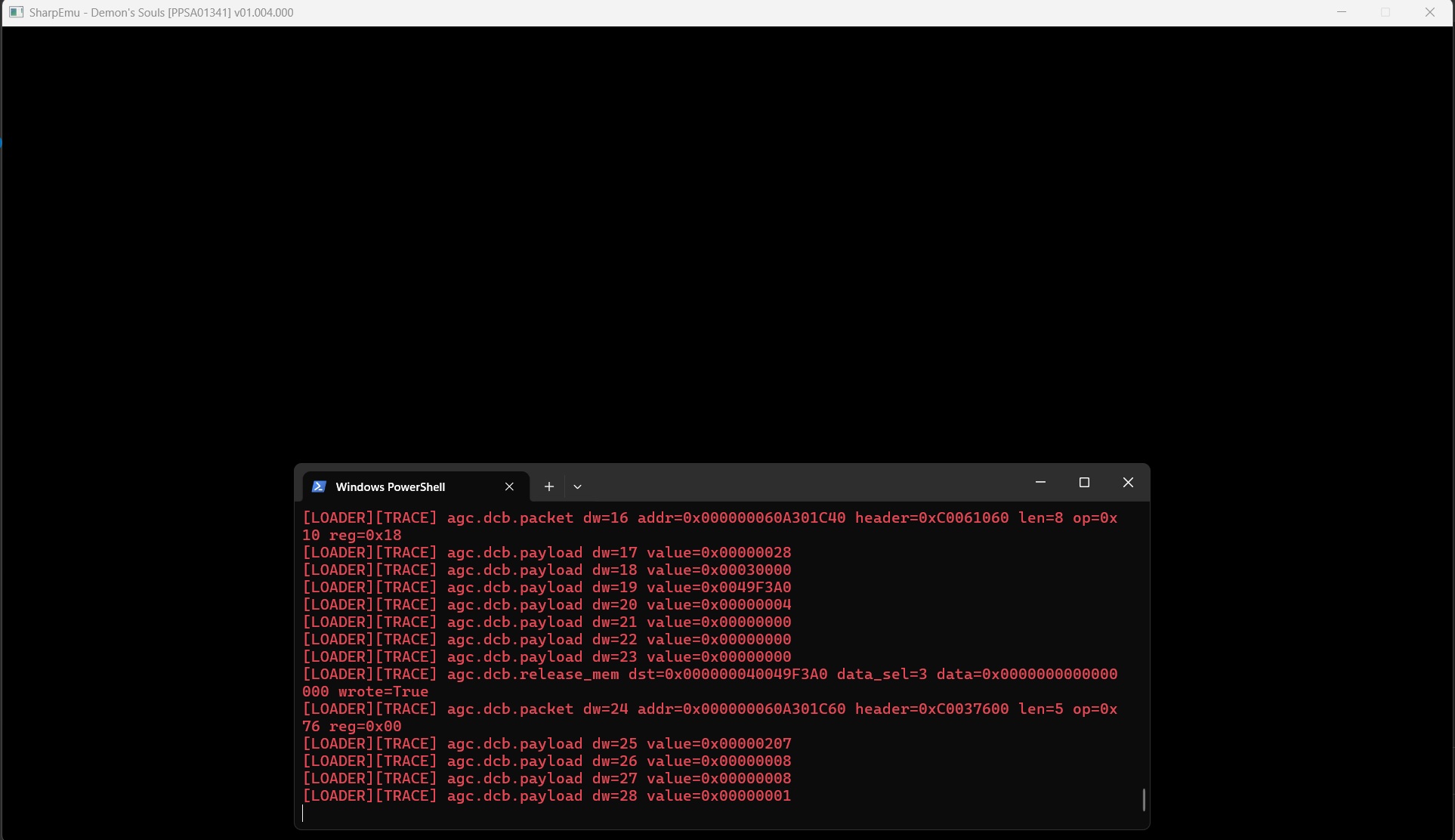
- Demon's Souls [PPSA01341]
- Demon's Souls is now video loop. Shaders are ready to be converted to SPIR-V/Vulkan. We are continuing our work on this.
-
Poppy Playtime Chapter 1
-
SILENT HILL: The Short Message
-
Dreaming Sarah
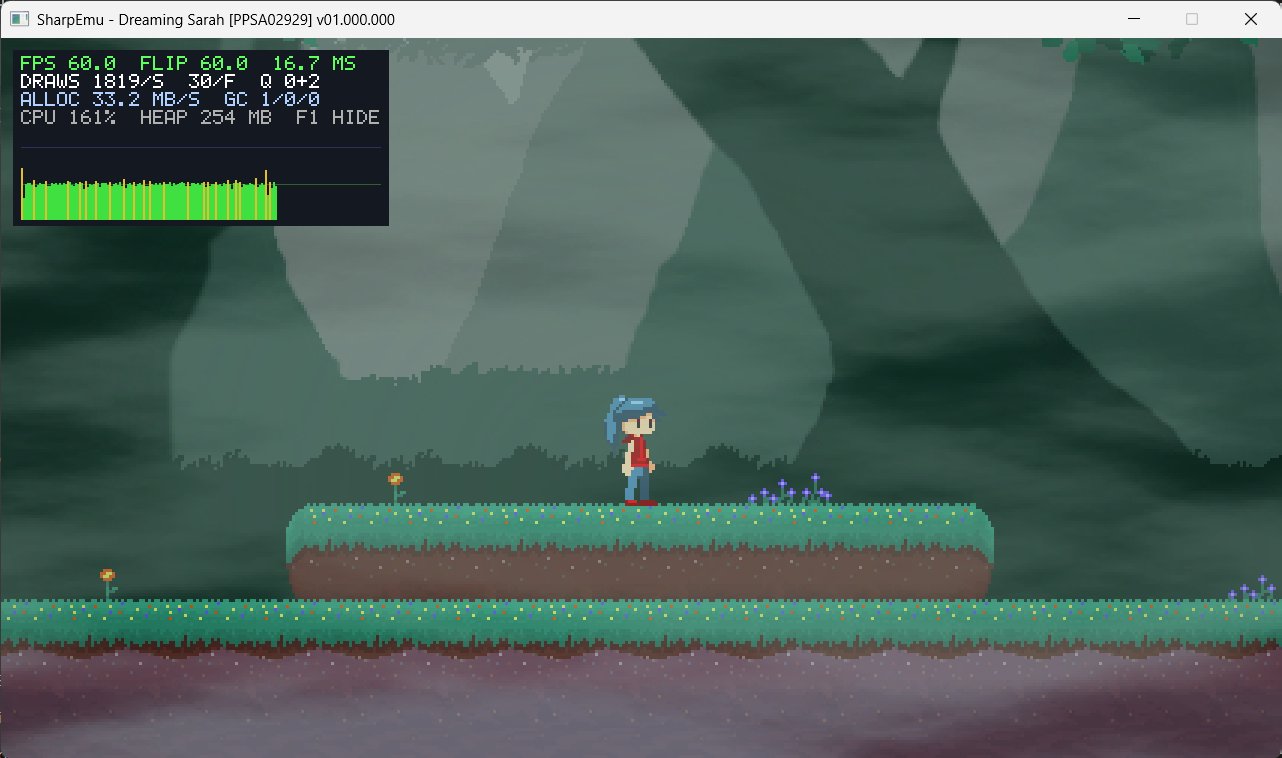
- Dreaming Sarah [PPSA02929]
- Real texture rendering for this game;


Important
This project does not support or condone piracy.
All games used during development and testing are dumped from consoles that we personally own.
Users are expected to use legally obtained copies of their games.
Build
- Install the .NET SDK.
- Clone the repository:
git clone https://github.com/par274/sharpemu.git - Open the solution file (
SharpEmu.slnx) in VSCode. - Build the project:
dotnet buildordotnet publish - Build artifacts will be located in the
artifactsdirectory.
Disclaimer
SharpEmu is an experimental emulator intended for research and educational purposes.
This project does not contain any copyrighted system firmware, game data, or proprietary PlayStation assets.
Special Thanks
The following projects were extremely helpful during development:
-
ShadPS4
Helped with understanding the basic architecture of the PlayStation 4. -
Kyty
One of the few PS5 emulator projects available and very useful for studying native code execution. -
Ryujinx
Provided valuable references for filesystem handling and low-level C# implementation patterns.
License
Contributing
Before opening an issue or pull request, please read our contribution guidelines:
The guide covers:
- Coding style and formatting
- AI-assisted contributions
- Pull request expectations
- Testing guidelines
- Legal and reverse engineering policy